I had a good tutorial with Linden at uni today. I think I went well over time, but we covered extensive ground. I have not finished thinking yet.
We discussed my draft proposal. I had described the culture in which I had worked, and Linden recommended I read Raymond Williams and Foucault. Williams was from a mining village in Wales and ended up at Cambridge post WW2, but discovered what his peer group meant by culture was completely different to what he meant by culture. He became interested in keywords, contemporary cognitive science and considered Residual, Dominant and Emergent culture.
We discussed Saucerre and how later thinkers concluded his work was flawed. Saucerre talked about the signifier and the signified and the relationship between them. However later thinkers feel the sign is arbitrary - it arises from accident rather than rule. His theory deals with sound, not meaning in language, and treats the sign as static, not moving with change or time. Because we are sensory beings, our bodies ground our value systems in our senses and his theory of semiotics does not take this into account.
The aim of my artwork proposal was clear: I am to take the theme of valuing under-valued people further than my BA, by considering women outside my family, celebrating skills and talents, both minor and major, to recognise and give value to their achievements. The body of work will utilise some historically significant format that women have used to express themselves, either personally or publicly (samplers, banners, garters). I need to "set rules for practice" - I am not sure what this entails (but I seem to have hit quite a lot of the requirements for the proposal, without being aware of what I was doing!). I was recommended to read Rosalind Krauss. I think she wrote about the Post Medium Condition. Art is no longer a technique which requires dedication to a sole medium - it is an argument about criticality in relation to other art. Concept is what is most important and in order to convey the concept, the artist uses the most appropriate technique and medium. This is what I feel I do, so this suits me!
I was also recommended to read:
Lambrous Malafouris ch 5 How things shape the mind;
Stuart Hall Representation: Cultural Representation and Signifying Practices;
Kathy Myers, Understains;
Laura Mulvey, Visual Pleasures and Narrative Cinema on the gendering of the gaze.
One of the things that I really like about Linden, is that she is very good at recommending reading. I am prepared to do the "hard reading" but find it a bit disheartening when what you choose/find is not in the right area, having taken books home, and plodded through them. So having someone who can target your energies is most helpful.
We also discussed imagery as the site (sight) of struggle. I like Gustav Courbet and his Stonepickers picture - portraying the lowest in society when the trend was about the great and the good. I see analogies with my work here.
We discussed postmodernism and how it deals with hierarchies in gender, ethnicity and orientation but does not deal with class. I have concerns about how PM can be cruel and my concerns about how this is portrayed on television, when it appears acceptable to set people up for a fall and then humiliate them in public. I find this distasteful and it affects my feeling about the whole genre. I think there is too much grief in the world and I don't find it acceptable to mock the afflicted.
I was advised to do some content analysis. Maybe about the representation of women in the popular imagination. Set some rule like portray of women in quiz shows in one evening on tv, or putting "women" into google images and seeing what patterns and trends you can see in the first 25 images that come up.
4 books from the library for starters. Not a lot then!
Tuesday, 10 November 2015

Sunday, 8 November 2015
Thoughts from the Bike Ride
I went for a 26 mile bike ride with Maurice today. This is the first time I have ridden for 3 weeks - my cold has lain on my chest for the last 2 weeks.
However, as usual, the exercise enabled me to come up with an idea. As I am thinking about doing a sampler about 6 ordinary women, it occurred to me that I should create a sketchbook about each one. I had a trial run at last art class where I made a little sketchbook about swimming, using my goggles as the object. But now, I have decided to interview Sharon and Anita about their respective Mums and see whether each is ok with me using her Mum as a subject for work. This will require an ethics form to be completed from uni, and I will stress that they can withdraw consent at every stage. I hope they don't, as I intend to be respectful and celebratory of what these women were.
I have thought quite a lot more about a suitable venue for this collection to be exhibited. I love the NPG and this is where I have been so inspired by Grayson Perry's work. But let's face it, I am never going to get exhibited there! But while out pedalling this morning, it occurred to me that Mrs Evans, Mrs Konieczny and Miss Evans (my old headmistress) all lived in Ilford. It is possible I could approach Valentines Mansion, National Trust property, in Ilford and see whether they might want a display that celebrated local women?
I had a tutorial with my tutor, Lewis. One of the things that came up was that I produce quite a lot of work. Another student does heaps of research and analysis, and makes one choice item. I am the opposite. I do a lot of research, but then do quite a lot of work. For my BA, I had 5 collections. Ihave been thinking about other formats for celebrating female achievements. I think the banner is symbolic of campaigners - this might fit well with suffragettes, unionists and other campaigners. So this might be a second collection.
I have been thinking about scale. Samplers are small, and choice. Banners are larger and attention seeking. I was wondering about going really big - I remember seeing huge images of Eleanor Simmonds and Tom Daly on the side of Westfield Shopping Centre. I wonder whether an artist could get their work portrayed that way? You would need to fit your artwork to a corporate agenda … and equality is on most large organisations mission statements. Hmmm!
Another thing that has been exercising my mind, is that I am interested in under-valued people. I am not anti-men. I don't want to alienate men who might be part of my audience. Have not finished thinking about this one yet. I might pose this as a question for the group presentation I need to give in early December.
However, as usual, the exercise enabled me to come up with an idea. As I am thinking about doing a sampler about 6 ordinary women, it occurred to me that I should create a sketchbook about each one. I had a trial run at last art class where I made a little sketchbook about swimming, using my goggles as the object. But now, I have decided to interview Sharon and Anita about their respective Mums and see whether each is ok with me using her Mum as a subject for work. This will require an ethics form to be completed from uni, and I will stress that they can withdraw consent at every stage. I hope they don't, as I intend to be respectful and celebratory of what these women were.
I have thought quite a lot more about a suitable venue for this collection to be exhibited. I love the NPG and this is where I have been so inspired by Grayson Perry's work. But let's face it, I am never going to get exhibited there! But while out pedalling this morning, it occurred to me that Mrs Evans, Mrs Konieczny and Miss Evans (my old headmistress) all lived in Ilford. It is possible I could approach Valentines Mansion, National Trust property, in Ilford and see whether they might want a display that celebrated local women?
I had a tutorial with my tutor, Lewis. One of the things that came up was that I produce quite a lot of work. Another student does heaps of research and analysis, and makes one choice item. I am the opposite. I do a lot of research, but then do quite a lot of work. For my BA, I had 5 collections. Ihave been thinking about other formats for celebrating female achievements. I think the banner is symbolic of campaigners - this might fit well with suffragettes, unionists and other campaigners. So this might be a second collection.
I have been thinking about scale. Samplers are small, and choice. Banners are larger and attention seeking. I was wondering about going really big - I remember seeing huge images of Eleanor Simmonds and Tom Daly on the side of Westfield Shopping Centre. I wonder whether an artist could get their work portrayed that way? You would need to fit your artwork to a corporate agenda … and equality is on most large organisations mission statements. Hmmm!
Another thing that has been exercising my mind, is that I am interested in under-valued people. I am not anti-men. I don't want to alienate men who might be part of my audience. Have not finished thinking about this one yet. I might pose this as a question for the group presentation I need to give in early December.
Wednesday, 4 November 2015
Writing my blog instead of riding my bike!
I am still full of the cold. I have had it for 8 days and I am not impressed. I wanted to do the Easy Rider bike ride today, but can't breathe well enough. So I will write up my class notes instead.
I think I have worked out something significant about how I want to use the sampler as an object. Samplers were worked by women and often portrayed something that was valued by the woman who made it. I think I want to use samplers to portray something valued of women.
I thought about ob - ject (thrown against) and ab - ject (thrown away). I intend to throw quite a lot of meaning against the sampler. I want to use the sampler as a vehicle to carry the meanings I throw against it.
I have also thought about how to make my series of works about women, appealing to a diverse audience. Often work that is about one group can exclude others. If I want my work to appeal to men as well, how do I achieve that? I am not a banner waving feminist. I believe women are hugely under-valued and frequently typecast into less important roles. But I want to use persuasion and positive representation to increase our profile. So do I need to include other types of people - ethnic minority, disabled, gay, ….? Actually, was this what Grayson Perry did in the National Portrait Gallery? He included all sorts of different people, including a straight white man (Liberal politician Chris Huhne). I think I need to get the first couple designed and done before I expand the range.
In class we discussed
Variation -v- consistency
Collection -v- series
Butterfly -v- linear
I think a collection of work has variation and the style and subject matter can butterfly about.
Whereas a series of work develops from one to next in a linear progress with consistent themes.
I could see a series of samplers about women. But I could also see a set of work on banners, about suffragettes from different countries (we were a long way behind in worldwide female suffrage); a set of tea towels about cooks who have improved cooking skills (not necessarily women!); a set of religious traditional clothing about the faithful who have achieved inter-faith tolerance ….
We were shown a form that helped identify your rules that define what you are trying to achieve:
Aim of the piece
To draw attention to the skills and talents of women
My Strategy for Achieving this:
Make samplers that are about women and their skills, rather than by a woman and what she values.
So the woman, as well as being the subject, becomes the object against which meaning is thrown.
The extent and ways in which I achieved my aim
The extent and ways in which my strategy did not work.
We discussed the difference between Essays, Reports, and Proposal:
Proposal - about the future, what you plan to do.
Report - A historical account of your process and outcomes. What went well/badly
Essays - more about argument and review of a subject.
We discussed making a plan for work. Use post-it notes to cover all key points of what you want to research. Put important comments or quotes on the back. Collect together and sequence them. Something like an organogram in business.
We get feedback on our draft proposals next week, and then need to present to the group on 8 December. We articulate the purpose of our proposals, and be clear what we want the group to contribute. 10 mins presentation, 20 mins discussion. My first thought is that I need to get the men to say what I need to include in my Valuing Women work, to appeal to men as well.
Gareth had a helpful suggestion when he saw my Artist Research folder. He creates an artistography - 50 words per artist stating why the work is significant to him. I have noted key words about each artist already. Would 50 words add to this? Not sure.
I think I have worked out something significant about how I want to use the sampler as an object. Samplers were worked by women and often portrayed something that was valued by the woman who made it. I think I want to use samplers to portray something valued of women.
I thought about ob - ject (thrown against) and ab - ject (thrown away). I intend to throw quite a lot of meaning against the sampler. I want to use the sampler as a vehicle to carry the meanings I throw against it.
I have also thought about how to make my series of works about women, appealing to a diverse audience. Often work that is about one group can exclude others. If I want my work to appeal to men as well, how do I achieve that? I am not a banner waving feminist. I believe women are hugely under-valued and frequently typecast into less important roles. But I want to use persuasion and positive representation to increase our profile. So do I need to include other types of people - ethnic minority, disabled, gay, ….? Actually, was this what Grayson Perry did in the National Portrait Gallery? He included all sorts of different people, including a straight white man (Liberal politician Chris Huhne). I think I need to get the first couple designed and done before I expand the range.
In class we discussed
Variation -v- consistency
Collection -v- series
Butterfly -v- linear
I think a collection of work has variation and the style and subject matter can butterfly about.
Whereas a series of work develops from one to next in a linear progress with consistent themes.
I could see a series of samplers about women. But I could also see a set of work on banners, about suffragettes from different countries (we were a long way behind in worldwide female suffrage); a set of tea towels about cooks who have improved cooking skills (not necessarily women!); a set of religious traditional clothing about the faithful who have achieved inter-faith tolerance ….
We were shown a form that helped identify your rules that define what you are trying to achieve:
Aim of the piece
To draw attention to the skills and talents of women
My Strategy for Achieving this:
Make samplers that are about women and their skills, rather than by a woman and what she values.
So the woman, as well as being the subject, becomes the object against which meaning is thrown.
The extent and ways in which I achieved my aim
The extent and ways in which my strategy did not work.
We discussed the difference between Essays, Reports, and Proposal:
Proposal - about the future, what you plan to do.
Report - A historical account of your process and outcomes. What went well/badly
Essays - more about argument and review of a subject.
We discussed making a plan for work. Use post-it notes to cover all key points of what you want to research. Put important comments or quotes on the back. Collect together and sequence them. Something like an organogram in business.
We get feedback on our draft proposals next week, and then need to present to the group on 8 December. We articulate the purpose of our proposals, and be clear what we want the group to contribute. 10 mins presentation, 20 mins discussion. My first thought is that I need to get the men to say what I need to include in my Valuing Women work, to appeal to men as well.
Gareth had a helpful suggestion when he saw my Artist Research folder. He creates an artistography - 50 words per artist stating why the work is significant to him. I have noted key words about each artist already. Would 50 words add to this? Not sure.
Friday, 30 October 2015
Why am I interested in The Object?
I have been reading The Object, edited by Antony Hudek, published in 2014. There is some interesting stuff in there.
Hudek writes about how objects define us. Ordinary mundane objects carry a variety of "disguises, concealments, subterfuges, provocations and triggers". They give multiple messages to different people. Objects exist before us and without us.
Dieter Roelstraete differentiates between Things and Objects. A thing has an earlier evolution than the object, as a thing has not acquired any relationship with a subject. The object has a more evolved status because it does have a relationship with a subject. An object has elevated status as it implies knowledge, control and ownership via possession and the ability to buy, sell trade or own it, by a subject.
Ob-ject - is derived from 'thrown against'. So does this mean the meanings we "throw against" it? Does this give the ob-ject 'worth'?
Ab-ject - is derived from "thrown away". Does this mean the ab-ject is denied of worth or has worth removed from it?
So as Walter Benjamin says, the artist "liberates things from the bondage of utility". This presumably indicates artists allocate a meaning to a thing, which elevates its status to an object. This give the artist a privileged position in rerouting, appropriating, and altering the object. Hudek reflects that as subjects with an extensive network of objects, we use them to learn about how to live, interact with others and organise ourselves publicly and privately. Provided this is accurate, the subject may be ready to accept that "Objects define us".
Stephen Willats, wrote about Transformers in 1989. Transformation is the taking of an object and the changing of its purpose, thereby creating another object. Its new meaning and function means the cultural references around it also change. The person or transformer who does this, recognises the underlying psychological possibilities by changing an object.
Objects hold a deep significance in modern Western society, in that objects signify the social power of the possessor and thus their authority. The object becomes a vehicle for society's desires and becomes an icon of a wider lifestyle choice. The creativity of the Transformer (artist) gives the object a new purpose which is other than its pre-determined role. When working in a standardised environment which restricts personal expression, tiny innocent transformations are notable, showing a rejection of imposed values. These transformation to the use and purpose of an object within a highly controlled environment are significant.
OK, so that is a bit of theory about The Object. If I try to apply this to my samplers, where do I get? If I think of a sampler as a thing, which had the bondage of utility of teaching girls to sew, and to learn their letters and numbers. I want to Transform it by using the sampler as a vehicle to publicise the actions of women who I respect. The traditional sampler was worked in a standardised format, but by articulate, specific expression of the values of the artist, a notable transformation could be achieved.
I am starting to change the way I feel about samplers. I had been quite surprised at my liking for such a traditional format, with its very simple stitch technique. I had been worrying about it being seen as old-fashioned, frumpy and unimaginative. But it does give the opportunity for a powerful social narrative, cogent with the technique, and demonstrating my understanding of the transformative power of the artist.
Hudek writes about how objects define us. Ordinary mundane objects carry a variety of "disguises, concealments, subterfuges, provocations and triggers". They give multiple messages to different people. Objects exist before us and without us.
Dieter Roelstraete differentiates between Things and Objects. A thing has an earlier evolution than the object, as a thing has not acquired any relationship with a subject. The object has a more evolved status because it does have a relationship with a subject. An object has elevated status as it implies knowledge, control and ownership via possession and the ability to buy, sell trade or own it, by a subject.
Ob-ject - is derived from 'thrown against'. So does this mean the meanings we "throw against" it? Does this give the ob-ject 'worth'?
Ab-ject - is derived from "thrown away". Does this mean the ab-ject is denied of worth or has worth removed from it?
So as Walter Benjamin says, the artist "liberates things from the bondage of utility". This presumably indicates artists allocate a meaning to a thing, which elevates its status to an object. This give the artist a privileged position in rerouting, appropriating, and altering the object. Hudek reflects that as subjects with an extensive network of objects, we use them to learn about how to live, interact with others and organise ourselves publicly and privately. Provided this is accurate, the subject may be ready to accept that "Objects define us".
Stephen Willats, wrote about Transformers in 1989. Transformation is the taking of an object and the changing of its purpose, thereby creating another object. Its new meaning and function means the cultural references around it also change. The person or transformer who does this, recognises the underlying psychological possibilities by changing an object.
Objects hold a deep significance in modern Western society, in that objects signify the social power of the possessor and thus their authority. The object becomes a vehicle for society's desires and becomes an icon of a wider lifestyle choice. The creativity of the Transformer (artist) gives the object a new purpose which is other than its pre-determined role. When working in a standardised environment which restricts personal expression, tiny innocent transformations are notable, showing a rejection of imposed values. These transformation to the use and purpose of an object within a highly controlled environment are significant.
OK, so that is a bit of theory about The Object. If I try to apply this to my samplers, where do I get? If I think of a sampler as a thing, which had the bondage of utility of teaching girls to sew, and to learn their letters and numbers. I want to Transform it by using the sampler as a vehicle to publicise the actions of women who I respect. The traditional sampler was worked in a standardised format, but by articulate, specific expression of the values of the artist, a notable transformation could be achieved.
I am starting to change the way I feel about samplers. I had been quite surprised at my liking for such a traditional format, with its very simple stitch technique. I had been worrying about it being seen as old-fashioned, frumpy and unimaginative. But it does give the opportunity for a powerful social narrative, cogent with the technique, and demonstrating my understanding of the transformative power of the artist.
Sunday, 25 October 2015
"Chalk" at Winchester Cathedral
I had a trip down to Winchester to attend the evening talk given by my friends Irena and Vanda, about their artwork in the exhibition. I arrived quite early so I could have a good look round during the afternoon.
Actually I found it all a little unsettling. I went into Winchester Cathedral and was uncomfortable in the atmosphere. As you entered and made your way up the building, there were extensive monuments to various local armed services units. A lot of remembrance of the glorious dead. Although I am not a Christian, I expect a church building to be about the worship of God, not about death through war. I found the labelling of the artworks to be unclear - I like a clear artist statement beside the artwork, and I like it to be easy to find. There was signage, but it was small and insignificant, and I could not read it without my glasses! This made me feel really middle-aged!
I met unexpectedly with friends from embroidery group, many years ago. We went to the Winchester Museum to look at more exhibits there. Had I not met Christina and Jackie, I would not have known the exhibition was at various different locations. We made our way round the museum, and again found the exhibits were not clearly marked. I had a leaflet that had an insert, that listed the exhibits, but Christina did not have the insert in her leaflet. All three of us struggled to understand the significance of the artworks.
Christina and Jackie went home before the talk, as it was a long journey home. I had booked overnight, as my purpose for being there was to hear the talk, and this event was from 6-8.30pm. This completely changed my experience of the event. I don't really get artwork about landscape, and fundamentally, this is what the theme "Chalk" is about. But once the poets starting reading their works, it completely changed the effect of the event. I still don't really get landscape, but one poem in particular "One More Mile" was lovely. As it was about the poet's father striding across the landscape, it gave me a narrative. And people and narrative is what I do.
By 7pm, we moved from the Museum, back to the Cathedral. Vanda and Irena's work "Laid to Rest" was very poorly lit, by the diffuse light focussed on an adjacent artwork. However the event organiser offered a line of tea lights, which were supplied, and I lit. This looked fantastic as the daylight completely faded and the tea lights were the main illumination.


Vanda and Irena gave a great explanation of what the work was about, and the significance of the materials they had chosen. The feeling of the cathedral completely changed in this event. There was atmospheric lighting, a community of artistic people, and genuine interest in the artworks and events going on. We watched a performance piece by two white clad dancers - quite mesmerising. The performers moved very slowly while poetry was quoted/read. I had never seen anything like it. The performers must have been very strong to hold some positions, and it gave the feeling of peace and power. A thought provoking combination.


Actually I found it all a little unsettling. I went into Winchester Cathedral and was uncomfortable in the atmosphere. As you entered and made your way up the building, there were extensive monuments to various local armed services units. A lot of remembrance of the glorious dead. Although I am not a Christian, I expect a church building to be about the worship of God, not about death through war. I found the labelling of the artworks to be unclear - I like a clear artist statement beside the artwork, and I like it to be easy to find. There was signage, but it was small and insignificant, and I could not read it without my glasses! This made me feel really middle-aged!
I met unexpectedly with friends from embroidery group, many years ago. We went to the Winchester Museum to look at more exhibits there. Had I not met Christina and Jackie, I would not have known the exhibition was at various different locations. We made our way round the museum, and again found the exhibits were not clearly marked. I had a leaflet that had an insert, that listed the exhibits, but Christina did not have the insert in her leaflet. All three of us struggled to understand the significance of the artworks.
Christina and Jackie went home before the talk, as it was a long journey home. I had booked overnight, as my purpose for being there was to hear the talk, and this event was from 6-8.30pm. This completely changed my experience of the event. I don't really get artwork about landscape, and fundamentally, this is what the theme "Chalk" is about. But once the poets starting reading their works, it completely changed the effect of the event. I still don't really get landscape, but one poem in particular "One More Mile" was lovely. As it was about the poet's father striding across the landscape, it gave me a narrative. And people and narrative is what I do.
By 7pm, we moved from the Museum, back to the Cathedral. Vanda and Irena's work "Laid to Rest" was very poorly lit, by the diffuse light focussed on an adjacent artwork. However the event organiser offered a line of tea lights, which were supplied, and I lit. This looked fantastic as the daylight completely faded and the tea lights were the main illumination.


Vanda and Irena gave a great explanation of what the work was about, and the significance of the materials they had chosen. The feeling of the cathedral completely changed in this event. There was atmospheric lighting, a community of artistic people, and genuine interest in the artworks and events going on. We watched a performance piece by two white clad dancers - quite mesmerising. The performers moved very slowly while poetry was quoted/read. I had never seen anything like it. The performers must have been very strong to hold some positions, and it gave the feeling of peace and power. A thought provoking combination.


Saturday, 24 October 2015
A quick idea - Needing to be named
Just a quick line before I rush off out for the day.
I have been thinking about which people I want to represent. Mostly they are what I call 'the little people'. I am not interested in the great and the good. But often the unknown people who do good and kind things that ease life's path.
I was thinking about the WW1 portraiture exhibition at the NPG that I went to about 18 months ago. This exhibition made the point that people with high status in WW1 were portrayed in named portraits, clean, fully suited and booted, with medals etc. However if a lower rank were portrayed, they would be a generic type, unnamed, often dirty, or dead. So there is something about the everyday and mundane being disassociated with and individual name.
Last Christmas I had a trip to Liverpool for a few days, and went to the Liverpool Museum amongst others. There was a great exhibition about women of Liverpool over the last century. But what was interesting, was they had made a great play of displaying the names of the women, and a short note about why they were significant.
I want my work to be about the domestic and mundane, the unsung heros/heroines. And these individuals need to be named.
I have been thinking about which people I want to represent. Mostly they are what I call 'the little people'. I am not interested in the great and the good. But often the unknown people who do good and kind things that ease life's path.
I was thinking about the WW1 portraiture exhibition at the NPG that I went to about 18 months ago. This exhibition made the point that people with high status in WW1 were portrayed in named portraits, clean, fully suited and booted, with medals etc. However if a lower rank were portrayed, they would be a generic type, unnamed, often dirty, or dead. So there is something about the everyday and mundane being disassociated with and individual name.
Last Christmas I had a trip to Liverpool for a few days, and went to the Liverpool Museum amongst others. There was a great exhibition about women of Liverpool over the last century. But what was interesting, was they had made a great play of displaying the names of the women, and a short note about why they were significant.
I want my work to be about the domestic and mundane, the unsung heros/heroines. And these individuals need to be named.
Friday, 23 October 2015
Art class
I have been thinking about women whose skills I respect. My friend, Sharon's Mum died recently. Ann Evans was very kind to me when I was at Junior School. Sharon was very worried about joining a swimming club to learn to swim, so Mrs Evans suggested to my parents that she took me along too. I would not have had the chance to go to swimming club without this. For about 3 or 4 years, Mrs Evans took us to swimming club and this has led to swimming being my exercise of choice ever since. So for the next few weeks at art class, I will be exploring objects that remind me of people who have been kind to me.
This week we were making our own sketchbooks. We took a selection of papers, and joined them using glue, staples, threading, stitch etc, stitched down the centre and folded in half, so we ended up with a sketchbook, c7" square. The object I chose to work from this week was a pair of swimming goggles. I also had an image of Fullwell Cross pool and a swimmer. We created various pages of our sketchbooks - then were instructed to chop them in half, and put one book into the centre of the other. This meant we had a partly completed sketchbook, 7" c3.5". We then worked into them again. We had a great day.


This week we were making our own sketchbooks. We took a selection of papers, and joined them using glue, staples, threading, stitch etc, stitched down the centre and folded in half, so we ended up with a sketchbook, c7" square. The object I chose to work from this week was a pair of swimming goggles. I also had an image of Fullwell Cross pool and a swimmer. We created various pages of our sketchbooks - then were instructed to chop them in half, and put one book into the centre of the other. This meant we had a partly completed sketchbook, 7" c3.5". We then worked into them again. We had a great day.
 |
| Stitch drawing of goggles with unthreaded sewing machine |

 |
| Fold out page - Collage swimmer, cut-out swimmer |
 |
| Cutout swimmer |
 |
| Line drawing of swimmer. Lovely high elbow! |
 |
| Goggles drawn large, with fluid medium (ink) |
 |
| With stitched line |
 |
| Reverse of page |

 |
| Image of pool with stitched name of pool. |
 |
| Serendipitious swimmer. Ink from other side has seeped through newsprint. So the straps of the goggles have become the swimmer. |
 |
| Line drawing of goggles, plus watery ink drawing of lane ropes |
 |
| Fullwell Cross swimming pool collage with lane ropes |
 |
| The windows at the pool. |
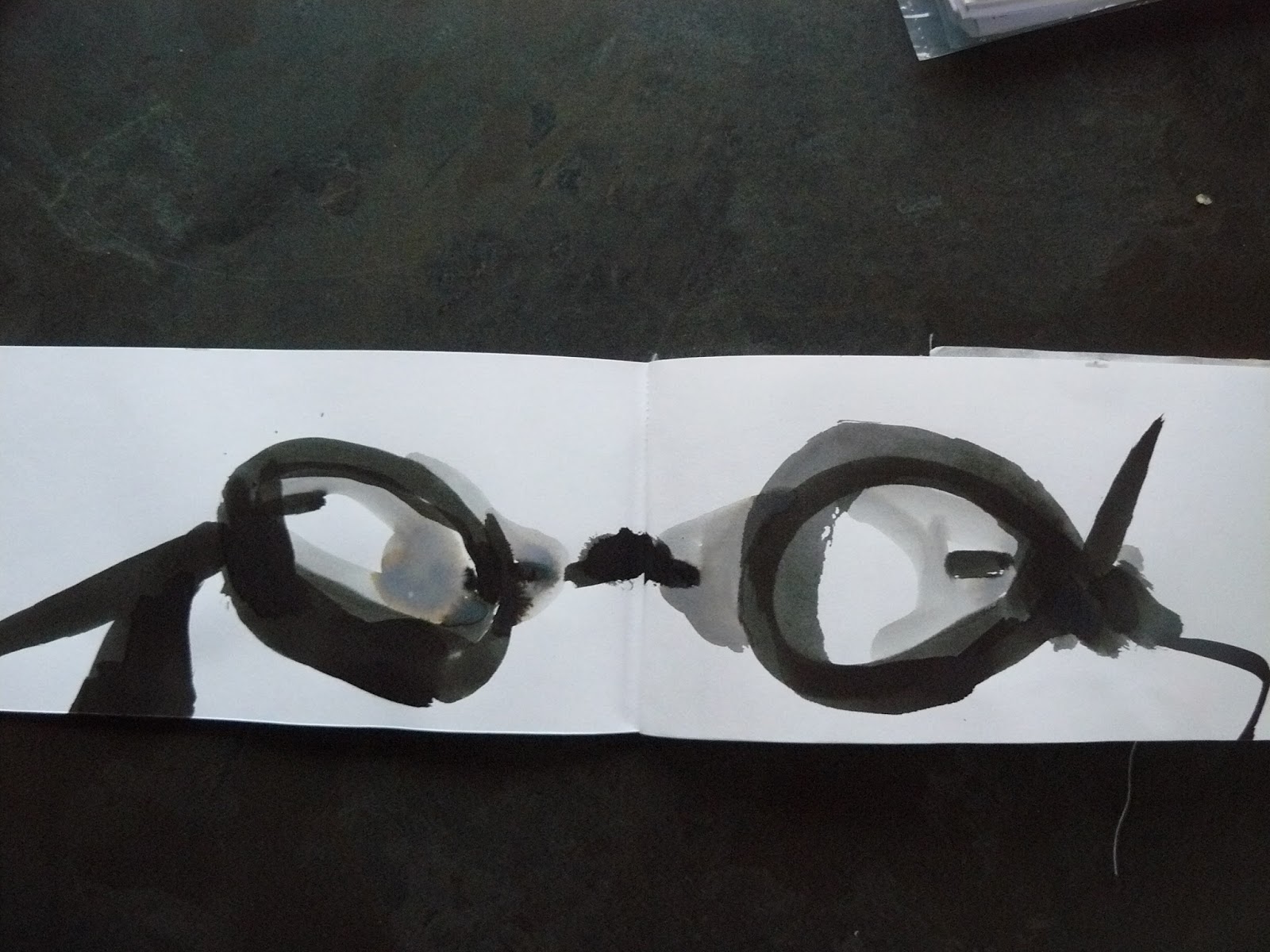 |
| Large scale goggles |
Subscribe to:
Posts (Atom)